 Strategy Generative AI Visibility February 12, 2026 Hema Dey
Read the full update here:
OpenAI has officially begun testing advertisements inside ChatGPT. This marks a structural shift in how conversational AI will be monetized and how brands can participate in AI-driven discovery.
Ref: https://openai.com/index/testing-ads-in-chatgpt/
If you work in marketing, advertising, or digital strategy, this is not a minor product update. It is the beginning of a new performance channel inside high-intent conversations.
Here is what is happening, what it means, and how to prepare.
OpenAI has confirmed it is piloting ads inside ChatGPT in the United States.
At this stage:
This is a controlled pilot, not a full ecosystem shift overnight. But it signals that AI interfaces are now monetizable environments, and brands will need a strategy.
Ref: https://searchengineland.com/openai-starts-testing-chatgpt-ads-468593
ChatGPT is no longer just a chatbot. It is increasingly functioning as a decision engine.
Users are asking by way of deep conversations:
These are high-intent queries. Unlike passive social scrolling, users are actively seeking guidance.
Advertising inside this context introduces a new model: contextual relevance within live decision-making.
For brands, this represents:
While the program is still in pilot phase, advertisers by invitation only can begin preparing immediately.
1. Register for OpenAI Advertising Updates
Monitor OpenAI’s announcements and register interest in early advertising access. Participation will likely be phased and limited at first.
2. Map Conversational Intent
Identify the exact questions your audience asks before purchasing. Think in natural language, not just keywords.
Examples:
“Best CRM for startups” and possible extensions to this conversation
“Affordable marketing automation tools” and possible extensions to this conversation
“How do I improve team productivity?” and possible extensions to this conversation
Your advertising strategy must align with these queries.
3. Build Conversationally Aligned Creative
ChatGPT is not a banner environment. Ads must feel relevant to the user’s question. Clear value propositions and direct alignment with user intent will outperform generic brand messaging. The term Answer Engine Optimization (AEO) comes into play here.
4. Define New KPIs
Traditional metrics still matter, but intent-driven performance becomes more important. Track:
Click-through rates by query category
Conversion rates tied to specific intent themes
Assisted conversions from AI discovery
5. Test Early
This is a new channel. Early experimentation will provide learning advantages before ad formats and pricing mature. If you need guidance let us know call Emma our AI Concierge to set up an appointment – +1 (949) 779 6442
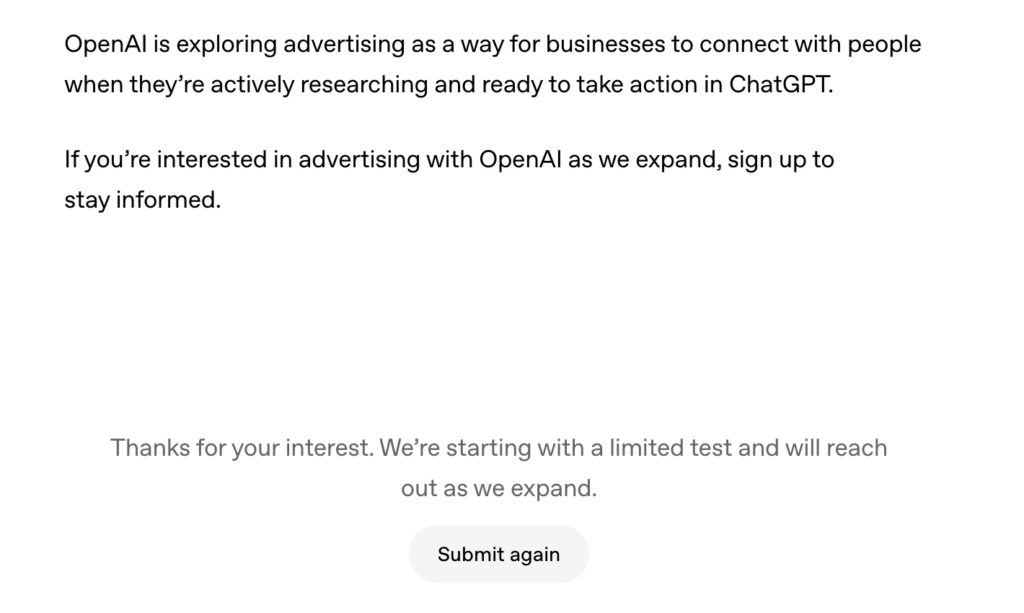
This is what Iffel got as a message when we registered to test the ChatGPT advertising platform. Fingers crossed we get in soon.
There has been visible chatter across Reddit and AI forums suggesting that ads will damage user trust or compromise privacy. The facts suggest otherwise. Ads do not influence ChatGPT’s answers. They are displayed separately and labeled clearly. Advertisers do not gain access to chat conversations. Only aggregate performance data is shared.
The rollout is limited and structured as a pilot to evaluate user experience and performance before broader expansion. Concerns about AI commercialization are understandable. However, the current implementation is designed to balance monetization with transparency and user control. We all await to see the true impact this is going to have for all parties.
Advertising is only one side of the equation. As ChatGPT becomes a discovery interface, brands must also think about organic visibility how they are referenced, cited, or surfaced inside AI responses.
This requires a new strategic approach to authority, content structure, and digital presence. If you want to understand how to position your brand for organic inclusion inside ChatGPT responses, I have written extensively on the subject.
You can explore everything we have published on how to rank on ChatGPT here:
https://www.iffelinternational.com/how-to-rank-on-chatgpt-for-businesses/
ChatGPT ads are not speculative. They are live, measured, and evolving. For brands, this is an early opportunity to define presence inside conversational AI before the channel becomes saturated. The question is no longer whether AI will become an advertising environment. It already has. The question is whether your brand will be ready.
Yes. OpenAI has officially confirmed that ads are being tested inside ChatGPT in a limited U.S. pilot. At this stage, ads are primarily being shown to logged-in adult users on the Free and ChatGPT Go tiers, while Plus, Pro, Business, Enterprise, and Education plans remain ad-free. This is not speculation anymore—it is the start of a new monetization layer inside conversational AI.
Right now, the best move is preparation. OpenAI is still in pilot mode, so access is likely controlled and phased. Brands should start by monitoring OpenAI’s advertising announcements, aligning creative with conversational intent, and building campaigns around the types of questions customers ask before buying. If you want to win early, you need to think in prompts and user intent, not just keywords.
This is the biggest concern I see across AI communities, and the answer is: not in the way people are assuming. OpenAI has stated that ads are clearly labeled and shown separately from ChatGPT’s responses, meaning they are not shaping the answer itself. They’ve also stated advertisers do not get access to personal chat content—only aggregated performance data like impressions and clicks. The rollout is designed to be controlled, transparent, and tested carefully before expansion.
Call Us: 949-779-6442
If you are falling in love with us,
learn our love language with this eBook
before we seal the deal...

