 Strategy Branding Generative AI January 14, 2026 Hema Dey
Read the full article here:
We are entering a decisive moment in digital marketing an AI reset that is fundamentally changing how brands are discovered, evaluated, and trusted.
Yet many marketing teams are still operating on outdated assumptions. The most common misstep I see today is the belief that content strategy is primarily about keyword research.
That approach is no longer sufficient.
AI platforms already answer elementary, keyword-based questions exceptionally well. When brands continue to produce content designed only to compete on keywords, they fail to meet both user expectations and AI’s evolving evaluation standards.
Search has shifted from simple retrieval to contextual, conversational intelligence.
AI is no longer just indexing pages it is assessing credibility, consistency, and intent. Every piece of content is evaluated through questions such as:
If your content cannot clearly answer those questions, it will struggle to gain visibility regardless of how well it is optimized for keywords.
Modern content must be semantic by design.
This means that every asset whether a blog, video, webinar, or social post should intentionally incorporate:
These intents should not exist in isolation. They must be woven together into a single, cohesive experience.
This framework applies across all industries, from professional services to ecommerce and enterprise technology.
One of the most overlooked aspects of AI-era marketing is validation.
AI does not rely on claims alone. It looks for corroboration.
Validation comes from:
Without validation, even strong thought leadership struggles to gain traction. In an AI-driven ecosystem, trust is built through patterns not proclamations.
Content does not exist in a vacuum. The technical environment it lives in matters just as much as the message itself.
A slow or poorly structured website limits how effectively AI can engage with your content.
At a minimum, organizations should ensure:
This is not about chasing perfect Core Web Vitals scores. It is about technical fluency ensuring your website speaks the same language as modern AI platforms.
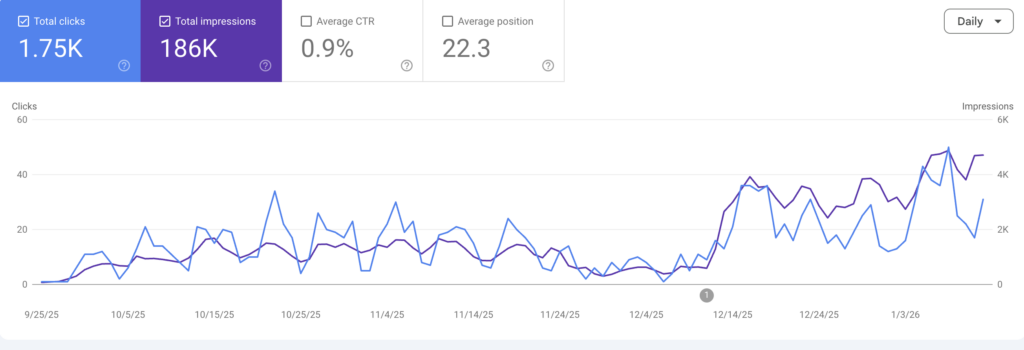
This is a clip from a client’s Google Search Console result after we implemented AI first strategy with content and technology on the website. Needless to say this correlated with higher number of new leads.
Automation without strategy leads to noise.
Every organization should define at least three core content pillars that reflect:
For example, in professional services, two firms may offer the same service but their thinking, decision-making frameworks, and client experience are rarely identical. That differentiation should be clearly articulated and reinforced through content.
Once pillars are defined:
AI connects dots. Strategic structure helps it do so accurately.
Canonical alignment is another critical, yet frequently underestimated, factor.
Your brand’s canonical signals must be consistent across:
When inconsistencies exist, AI may interpret them as separate entities. This fragmentation weakens authority and reduces trust.
A canonical audit is no longer optional it is foundational.
Siloed digital marketing strategies where content, SEO, and website technology operate independently are already obsolete.
The brands that will win in 2026 understand one core principle:
Content strategy, validation, and website performance must work together as a single system.
That alignment is the handshake AI is looking for.
At Iffel International, we help organizations build that alignment so their insights are not only published, but trusted, understood, and surfaced in an AI-first world.
AI-driven search experiences like Google AI Overviews, ChatGPT, and other large-language model platforms are increasingly replacing traditional click-based search. These systems prioritize direct answers, contextual relevance, and trust signals over old-school keyword ranking strategies. Simply chasing keywords no longer drives visibility. Wikipedia
Navigational intent: Business owners want to understand where and how their content appears in AI search results across platforms.
Commercial intent: They need to evaluate optimization services, tools, and frameworks (e.g., AEO/GEO strategies) that improve visibility.
Transactional intent: They are evaluating whether to invest in audits, AI content tools, or expert consulting for AI optimization.
With AI summaries appearing at the top of many searches and zero-click results becoming more common, business leaders worry that traditional SEO doesn’t deliver ROI anymore. WPBeginner
Informational intent: They want to know the role of SEO post-AI, what still works, and how visibility is measured when users don’t click.
Commercial intent: They’re considering budget allocation between traditional SEO, AI optimization, and content strategy.
Transactional intent: They want to decide whether to hire or invest in AI-driven optimization services.
Simply producing text for keywords is no longer enough. Brands must craft content that demonstrates intent understanding, expertise, authority, and usefulness — the signals that AI systems prioritize. Content Marketing Institute
Informational intent: Leaders want frameworks for how to structure content so AI can interpret and value it.
Commercial intent: They want to understand content pillars, validation, and entity trust that drives both AI prominence and audience engagement.
Transactional intent: They are looking for frameworks that drive measurable outcomes (lead capture, conversions, search presence).
Call Us: 949-779-6442
If you are falling in love with us,
learn our love language with this eBook
before we seal the deal...

