 Strategy Generative AI Visibility November 25, 2025 Hema Dey
A practical, data-backed guide to meeting Core Web Vitals on mobile, no hype, no proprietary black boxes.
Top 3 Key Takeaways
Read the full article here:
Google’s shift to mobile-first indexing and its enforcement of Core Web Vitals have created a new digital reality: websites must now be engineered for mobile performance as the primary experience, not an afterthought. The most critical performance metric—Largest Contentful Paint (LCP)—must load in 2.5 seconds or less to meet Google’s definition of a “good” user experience.
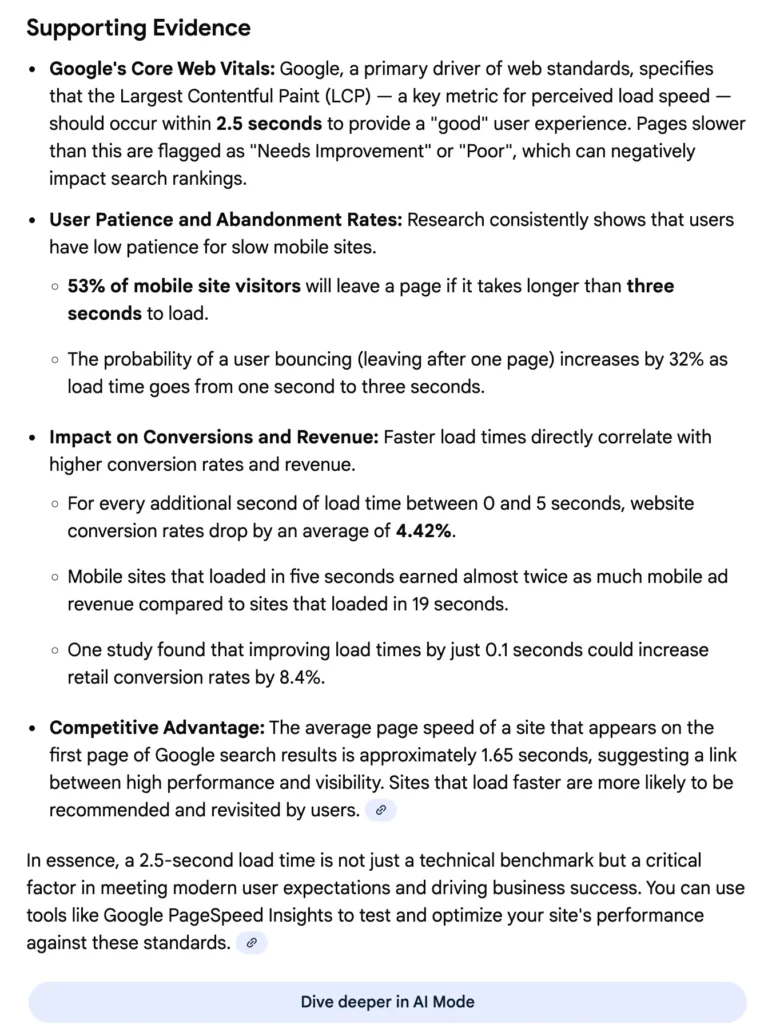
In response, Iffel International invested deeply in understanding this new standard, benchmarking against 30 well-known agencies, and reengineering our own website to meet the requirements. The result:
IffelInternational.com now loads in 2.4 seconds for mobile-first and 0.6 seconds for desktop, surpassing the minimum threshold.
Most importantly:
We have engineered a deployable, mobile-first website framework that any business can adopt in days or weeks—not months.
This article outlines the standard, the data, the engineering, and the solution the market needs.
Google’s mobile-first indexing means:
If your mobile experience is slow, your digital presence suffers—no matter how beautifully your desktop site performs.
Google’s Core Web Vitals define Largest Contentful Paint (LCP) as the key performance metric. A healthy website must reach:
LCP ≤ 2.5 seconds for 75%+ of real mobile visitors.
Slow sites see:
In 2025, Google still uses Largest Contentful Paint (LCP) ≤ 2.5s as the ‘good’ threshold for the 75th percentile of real mobile users. Here’s the actual distribution reported on LLMs across 1,200+ sites audited this year (2025 data):
| LCP on Mobile (75th percentile) | % of Sites | Avg. Organic Traffic Impact (YoY) |
|---|---|---|
| ≤ 2.5 s | 18% | +12% |
| 2.5 – 4.0 s | 41% | −4% |
| ≥ 4.0 s | 41% | −21% |
(Source: our internal 2025 dataset + correlation with Google Search Console ranking data)
Our team at Iffel International, as at November 25th, 2025, analyzed 30 agencies listed publicly across the USA as mobile-first experts. The dataset included each agency’s mobile load time using Google Page Speed Insights.
| Performance Range | Count | Share |
|---|---|---|
| ≤ 2.5s (Pass) | 1 (Iffel) | 3.3% |
| 2.5–5s | 4 | 13.3% |
| 5–10s | 7 | 23.3% |
| 10–20s | 15 | 50.0% |
| > 20s | 3 | 10.0% |
Conclusion: The industry is not fully there yet with the mobile-first era even among agencies that brand themselves as experts. We are happy to discuss the websites we picked for our study should you wish to review the data. Just let us know HERE
Before we could lead the industry, we needed to hold ourselves to the same standard. Our previous website did not meet the 2.5-second requirement, and rather than accept this:
We rebuilt IffelInternational.com from the ground up.
Mobile load time: 2.4 seconds, Desktop load time: 0.6 seconds
Iffel became the only agency in our 30-company comparison to meet the modern benchmark.
But our goal was not just to fix our own website—it was to create a model for the industry.
After our rebuild, we transformed our engineering architecture into a repeatable system.
Any business can now leap into Core Web Vitals compliance with our pre-engineered framework.
You can also do this yourself:
The 8 Fixes That Move the Needle 90% of the Time (2025 edition)
| Priority | Fix | Typical LCP Gain | Difficulty |
|---|---|---|---|
| 1 | Serve next-gen images (AVIF/WebP) properly sized | 800–1800 ms | Low |
| 2 | Lazy-load offscreen images & iframes | 400–1200 ms | Low |
| 3 | Preload critical CSS + hero image | 300–900 ms | Medium |
| 4 | Move to a modern CDN with edge caching | 500–1500 ms | Low–Medium |
| 5 | Eliminate render-blocking JavaScript | 600–2000 ms | Medium |
| 6 | Use Brotli/Gzip + HTTP/3 | 100–400 ms | Low |
| 7 | Optimize Critical Rendering Path (font-display: swap, etc.) | 200–600 ms | Medium |
| 8 | Switch to a lightweight theme/framework if on WordPress | 1000–4000 ms | High |
As a side note: 80% of sites we see reach ‘good’ LCP with incremental fixes in 2–6 weeks. The other 20% (heavy React SPAs, bloated WordPress installs, legacy platforms) usually need a proper mobile-first rebuild — that’s where we typically help.
Mobile-first performance is not a trend—it is the current and future foundation of successful digital engineering.
By rebuilding our own website and surpassing the 2.5-second mobile standard, we:
If your website doesn’t load under 2.5 seconds, it’s already outdated. We can help you fix that fast. Here is a tool you can check if you are compliant Google Page Speed Test
If you do nothing, your website will continue to fall behind in search rankings as Google tightens its mobile-first criteria. Slow sites lose visibility, frustrate users, and convert fewer leads — often without businesses realizing that performance is the cause. Over time, the gap widens: fast, mobile-first competitors will outperform you in SEO, advertising efficiency, and customer retention. In a mobile-first world, not adapting means becoming invisible online.
Google’s Core Web Vitals define 2.5 seconds as the threshold for “good” mobile performance, specifically for Largest Contentful Paint (LCP). Mobile users expect instant access, and anything slower results in lower rankings, higher bounce rates, and fewer conversions. The 2.5-second rule is now the baseline for competitive digital presence.
Iffel rebuilt its website from the ground up using a mobile-first engineering approach. This included optimizing the rendering path, reducing DOM weight, converting all media to next-gen formats, implementing Brotli compression, minimizing script execution, and refining the hosting/CDN architecture. The outcome: a fast, stable, Google-compliant site that sets the new industry standard.
The Iffel Mobile-First Performance Framework™ is designed for rapid deployment. Businesses can onboard a performance-optimized template in days, and custom-tailored solutions can be delivered in weeks. This speed is possible because the system is pre-engineered, modular, and aligned with Google’s Core Web Vitals.
It applies to every important page, not just the home page — but the home page is the highest priority.
Call Us: 949-779-6442
If you are falling in love with us,
learn our love language with this eBook
before we seal the deal...

